
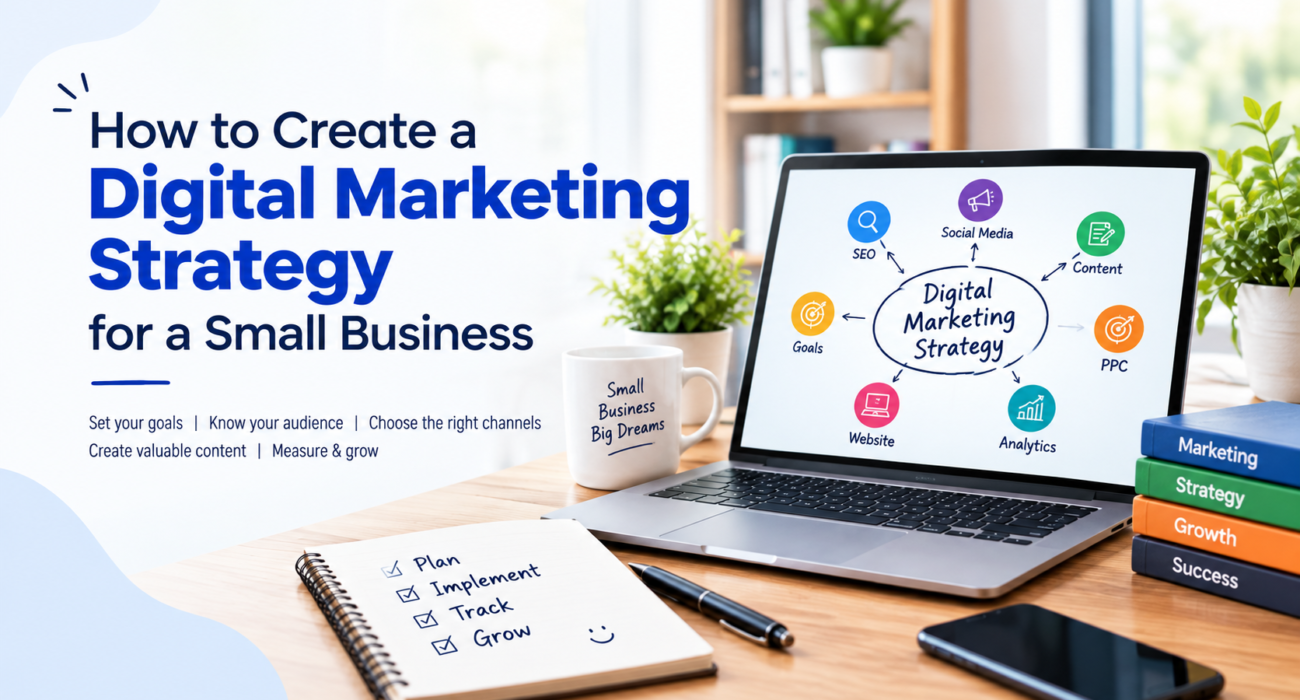
In today’s competitive online environment, having a digital presence is no longer optional for small businesses. Whether you run a local store, a professional service, an e-commerce business, or a growing startup, your customers are likely searching online before making a purchase or contacting you.
However, simply having a website or social media account does not guarantee results. Small businesses need a clear digital marketing strategy that connects their business goals with the right online channels, audience, content, and measurable outcomes.
The good news is that you do not need a huge marketing budget to get started. A well-planned strategy can help you focus your resources on activities that are relevant to your customers and business objectives.
1. Define Your Business Goals
The first step in creating a digital marketing strategy is understanding what you want to achieve.
Your goals should be specific rather than simply saying, “I want more customers.” For example, your business goals could include:
- Increasing website traffic
- Generating more leads
- Increasing online sales
- Improving local visibility
- Building brand awareness
- Increasing repeat purchases
- Growing your social media audience
Try to make your goals measurable and time-bound. For example, instead of saying “increase website traffic,” you could aim to increase organic website visits over a specific period.
Clear goals make it easier to decide which marketing channels deserve your attention and how you will measure progress.
2. Understand Your Target Audience
Effective marketing begins with understanding the people you want to reach.
Create a basic customer profile by considering factors such as:
- Age and location
- Profession or industry
- Interests and preferences
- Common problems or needs
- Purchasing habits
- Budget
- How they search for products or services
For example, a local fitness studio may target working professionals living within a specific area, while an online software company may target business owners across multiple cities or countries.
Understanding your audience also helps you create content that answers real questions instead of publishing content simply to stay active.
3. Build a Strong Online Foundation
Before investing heavily in advertising or social media, make sure your basic digital presence is trustworthy and easy to use.
Your website should clearly communicate:
- What your business offers
- Who you serve
- Why customers should consider you
- How customers can contact or purchase from you
Make sure your website is mobile-friendly, easy to navigate, and reasonably fast. Important pages such as your services, products, contact information, and frequently asked questions should be easy to find.
For local businesses, a properly maintained Google Business Profile can also help customers discover important information such as your location, business hours, services, reviews, and contact details.
4. Choose the Right Digital Marketing Channels
Small businesses do not necessarily need to be active on every digital platform.
Instead, choose channels based on where your target audience spends time and how they search for solutions.
Search Engine Optimization (SEO)
SEO helps your website become more visible in search engine results. A basic SEO strategy can include keyword research, useful content, technical improvements, internal linking, and optimizing relevant website pages.
For local businesses, local SEO can be particularly important because potential customers may search for products or services in their area.
Social Media Marketing
Social media can help businesses communicate with their audience, showcase their products or services, answer questions, and build brand recognition.
Choose platforms that make sense for your audience rather than trying to maintain every available account.
Content Marketing
Content marketing involves creating useful information that addresses your audience’s questions and needs. Depending on your business, this could include blog posts, videos, guides, case studies, infographics, or FAQs.
Good content should provide genuine value rather than simply promoting your business.
Paid Advertising
Platforms such as Google Ads and social media advertising can help businesses reach specific audiences more quickly. However, paid campaigns should have clearly defined objectives and tracking in place before you spend money.
5. Create Useful, Trustworthy Content
Content is one of the most important parts of a digital marketing strategy.
Instead of asking, “What should we post today?” start by asking, “What information does our customer need?”
For example, a digital marketing agency could create content around topics such as SEO basics, social media strategies, website optimization, and common marketing mistakes.
When developing content, focus on first-hand knowledge, accurate information, practical examples, and clear explanations. Where appropriate, support important claims with reliable sources.
Customer testimonials, case studies, original insights, author information, and transparent business details can also help establish trust.
6. Set a Realistic Marketing Budget
A digital marketing strategy should fit your financial resources.
Your budget may need to cover areas such as:
- Website development or maintenance
- SEO
- Content creation
- Social media management
- Paid advertising
- Design and video production
- Marketing tools and software
If your budget is limited, prioritize activities that support your most important business goal.
For example, a local service business may initially focus on local SEO, useful website content, and reputation management rather than spreading a small budget across numerous advertising platforms.
7. Track the Right Metrics
Marketing without measurement makes it difficult to understand what is working.
Your key performance indicators (KPIs) should relate directly to your objectives.
Depending on your strategy, you might monitor:
- Website traffic
- Organic search visibility
- Leads generated
- Conversion rate
- Cost per lead
- Online sales
- Social media engagement
- Return on advertising spend
- Customer acquisition cost
Avoid focusing only on vanity metrics such as follower counts. A smaller audience that generates qualified leads can be more meaningful to a business than a large audience with little commercial impact.
8. Test, Learn, and Improve
A digital marketing strategy should not remain unchanged forever.
Review your results regularly and identify what is producing useful outcomes. You can then adjust your content, targeting, website experience, advertising campaigns, or SEO priorities.
Testing different headlines, landing pages, advertisements, content formats, and calls to action can provide useful insights. However, changes should be evaluated using appropriate data rather than assumptions.
Remember that digital marketing is generally a process of continuous improvement, not a one-time activity.
Conclusion
Creating a digital marketing strategy for a small business does not have to be complicated. Start by defining clear business goals, understanding your target audience, building a trustworthy online presence, selecting relevant marketing channels, and creating genuinely useful content.
Most importantly, measure your efforts and use the results to improve your strategy over time.
For small businesses, consistency and relevance often matter more than simply being present on every platform. A focused digital marketing approach can help you use your available time and budget more effectively while building a stronger relationship with your target audience.
If you are unsure where to begin, consider starting with one clear objective, one well-defined audience, and a small number of marketing channels. As your understanding and results grow, you can gradually expand your strategy.